Robotic Adhesive Dispensing Your Operators Can Set Up Themselves
Most manufacturing plants reach a point where manual adhesive application becomes the production bottleneck. Volume grows but the process does not keep pace. Operators dispense inconsistently, bead patterns vary from part to part, and complex paths — circles, arcs, closed loops — are impossible to replicate by hand at production speed. The ADoST 3X-RDS1 is a compact desktop adhesive dispensing robot that closes this gap. It automates glue and sealant application on a 400mm × 400mm work area, controlled by a visual teach pad that any shop floor operator can learn to programme in a single day.
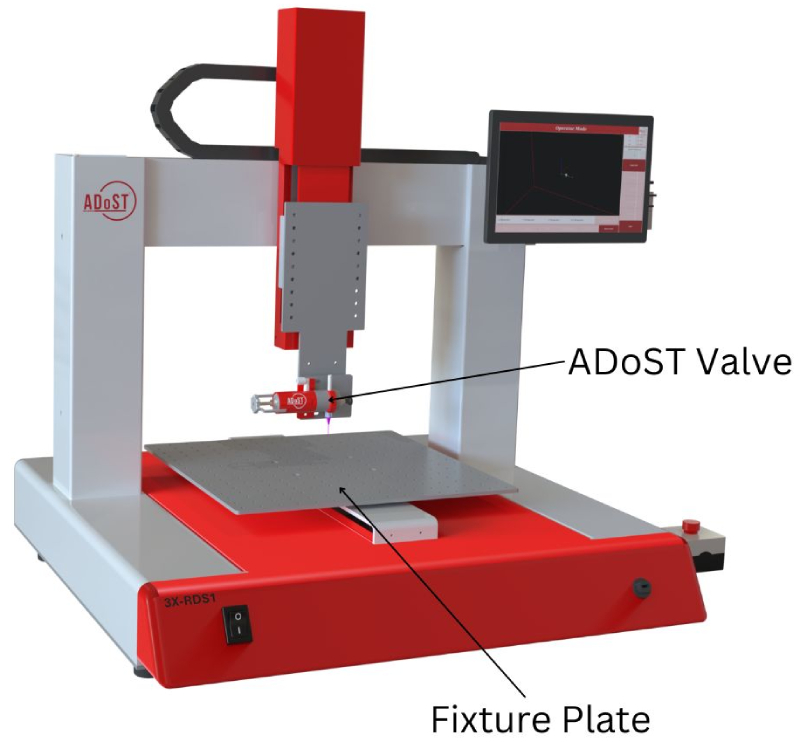
ADoST benchtop dispensing robot sits on a standard workbench, runs on 230V, and can be production-ready within hours of delivery. The operator positions the robot head at each key point on the part using the 10.1-inch HD touchscreen teach pad and saves those coordinates. The robot builds its dispensing path from those saved points and repeats the path with ±0.01mm repeatability, at speeds of up to 800mm/sec, for every part that follows.
The 3X-RDS1 is not a standalone machine — it is a complete robotic dispensing system that pairs with ADoST’s full range of dispensing machines or with the dispensing machines of any other make. Cyanoacrylate, Anaerobic, and UV adhesives flow through the ADoST PPS-NXT. Two-part Epoxy through the ADoST CDS. Silicone and PU sealants through the ADoST SDS. One adhesive dispensing robot — one platform for your entire adhesive and sealant operation.
Who Should Be Reading This?
The 3X-RDS1 is built for production and quality engineers who want industrial-grade dispensing automation that their own operators can set up and run. No system integrator. No custom engineering project. No lengthy commissioning. Just a purpose-built adhesive dispensing robot that is productive from day one
You will find this machine relevant if:
The Real Problems This Machine Solves
Problem 1
Manual Dispensing Cannot Hold a Consistent Path at Speed
A skilled operator can draw a bead by hand. But at production speeds — 200 or 500 parts per shift — quality drifts. Width varies, corners get cut, start and stop positions shift between operators and between shifts. Once programmed, the adhesive dispensing robot follows the same path for every cycle, on every shift, with ±0.01mm repeatability. The path never drifts.
Problem 2
Complex Geometries Cannot Be Replicated Manually
Circular beads around bearings, U-shaped paths along housing flanges, dot arrays on PCBs — these patterns are impossible to reproduce by hand at any consistent standard. The 3X-RDS1 supports dots, lines, arcs, and full circles. You teach it once using the visual touchscreen teach pad. It executes the same path accurately for every part after. This is what makes automated adhesive application viable on components that manual dispensing simply cannot serve.
Problem 3
Every Product Changeover Resets Operator Knowledge
When your line changes product, manual dispensing means briefing operators again — where to apply, how much, which path. The automatic glue dispensing machine approach that the 3X-RDS1 provides stores each product as its own saved program. Changeover is selecting the right program — not retraining a person. The machine remembers what the operator taught it.
Problem 4
Operator Fatigue Degrades Quality Over the Shift
In manual dispensing, the bond quality at 9am is not the same as the bond quality at 4pm. Fatigue changes pressure, speed, and positioning. The adhesive dispensing robot has no fatigue. Part 1 and Part 500 of the shift receive exactly the same application. In safety-critical applications — EV battery module bonding, medical device assembly — this consistency is non-negotiable.
Problem 5
You Need Dispensing Automation That Is Operational This Month
Commissioning a custom robotic dispensing system involves engineering scoping, civil preparation, safety guarding, PLC programming, and specialist installation. The timeline from decision to production is typically measured in months. The 3X-RDS1 runs on standard 230V, sits on any workbench, and is programmable by your own operator on day one. From delivery to first production cycle is measured in hours.
How the ADoST 3X-RDS1 Works
The 3X-RDS1 is a gantry-style 3-axis dispensing robot with X, Y, and Z movement. The dispensing tool — connected to the ADoST dispenser of your choice — mounts on the Z axis. As the robot moves through its programmed path, the dispenser controls when and how much fluid is released at each point.
Teaching a new program is something any operator can do — right on the machine
The operator uses the 10.1-inch HD capacitive touchscreen teach pad to position the robot head at each key point on the part and saves those coordinates. The adhesive dispensing robot builds its complete dispensing path from those saved points. There is no programming language to learn, no PLC to configure, and no automation engineer required on-site for setup or changeover.
Once programmed, the robot can execute automated adhesive application in any of these formats:
Programs are stored in the robot’s internal memory and backed up to USB. For multi-product lines, each product program is stored separately and recalled instantly — no re-teaching required between changeovers.
Compatible Dispensers — What Adhesives Can It Dispense?
The 3X-RDS1 is a platform, not a standalone dispenser. It pairs with ADoST dispensing machines to form a complete adhesive dispensing robot system. The dispenser controls the fluid volume and timing. The robot controls the path.
| Adhesive / Sealant Type | Compatible ADoST Dispenser |
|---|---|
| Cyanoacrylate — Superglue, Fevikwik type instant adhesive | ADoST PPS-NXT (CY variant) |
| Anaerobic — Threadlocker (Loctite 243, Loxeal 55-03), Retaining Compound, FIP Gasket | ADoST PPS-NXT (AN variant) |
| UV Adhesive — light-cure adhesive for glass, optical, and electronic bonding | ADoST PPS-NXT (UV variant) |
| Two-Part Epoxy — 1:1, 2:1, 4:1, 10:1 mix ratios | ADoST CDS / CDS PRO |
| Silicone Sealant / PU Sealant | ADoST SDS / SDS PRO |
If you are already running a manual ADoST dispenser — PPS-NXT, CDS, or SDS — upgrading to this adhesive dispensing robot requires no change to your adhesive process. Your existing dispenser connects directly. The robot adds the path automation on top. Not sure which combination fits your application? Book a free technical consultation and we will model the right setup for your part and adhesive.
ADoST 3X-RDS1 — Benchtop Dispensing Robot Technical Specifications
| Parameter | ADoST 3X-RDS1 |
|---|---|
| Bed Size | 400mm × 400mm × 160mm |
| Operational Range | 372mm × 392mm × 112mm |
| Outer Dimension | 724mm × 735mm × 800mm |
| Drive Mechanism | Belt Drive / Lead Screw Drive |
| Maximum Object Height | 160mm |
| Power Requirement | 230 VAC, 50Hz, 10A — standard Indian power supply |
| Axes of Movement | 3-axis (X, Y, Z) |
| Repeatability per Axis | ±0.01mm |
| Resolution per Axis | 0.1mm |
| Net Weight | 30 kg |
| Tool Load | Maximum 4 Kg |
| Application Object Load | Maximum 10 Kg |
| Maximum Speed (X, Y) | 800 mm/sec |
| Maximum Speed (Z) | 100 mm/sec |
| Programming Method | Visual teach pad — no coding required |
| Operating Temperature | 0°C to 40°C |
| Operating Humidity | 10% to 80% RH (non-condensing) |
| Data Storage | Internal memory + USB backup |
| Display | 10.1-inch HD capacitive touchscreen, LCD |
Key Features & Benefits of the 3-Axis Dispensing Robot
| Feature | What It Means for Your Production |
|---|---|
| ±0.01mm repeatability per axis | Every part receives adhesive in the exact same position, every cycle |
| 800mm/sec XY speed | Production-rate dispensing — not just lab or prototype use. |
| Visual teach pad programming | No code. No PLC. Any operator can teach a new path in minutes on the touchscreen |
| 10.1-inch HD touchscreen | Large, clear, shop-floor-ready display. Easy to read and operate. |
| Program memory + USB backup | Store programs per product. Recall instantly. No re-teaching between changeovers. |
| 400mm × 400mm work area | Covers a wide range of part sizes — from PCBs to large automotive housings. |
| Supports automated adhesive application in dots, lines, arcs, and circles | Handles complex paths that manual dispensing cannot replicate consistently. |
| 10 Kg application object load | Handles real production parts, not just lightweight samples. |
| 230V standard power — benchtop footprint | No civil work. No special electrical infrastructure. Deploy anywhere on the floor. |
| Compatible with all ADoST dispensers | One robotic dispensing system for Cyanoacrylate, Anaerobic, UV, Epoxy, and Silicone. |
Where the Adhesive Dispensing Robot Is Used — Industry Applications
The adhesive dispensing robot is deployed across industries where dispensing is high-frequency, the path is fixed, and bond quality is a measurable production output.